Grad-CAM generation and visualization tutorial
[1]:
import os
import configparser
import logging
import numpy as np
import torch
import cv2
from PIL import Image
from meegnet.viz import compute_cams, plot_cam
import matplotlib.pyplot as plt
from pytorch_grad_cam import GradCAM
from meegnet.dataloaders import EpochedDataset
from meegnet.network import Model
from mne.viz import plot_topomap
from sklearn.decomposition import PCA
import torch.nn.functional as F

info = np.load(f"../camcan_info_mag.npy", allow_pickle=True).tolist()
/home/arthur/.pyvenv/meegnet/lib/python3.12/site-packages/tqdm/auto.py:21: TqdmWarning: IProgress not found. Please update jupyter and ipywidgets. See https://ipywidgets.readthedocs.io/en/stable/user_install.html
  from .autonotebook import tqdm as notebook_tqdm
[2]:
# We set up our data to be 3 channel types (MAG GRAD GRAD),
# 102 sensor locations (Elekta Neuromag Vector View 306 channel MEG),
# and 400 time samples for 800ms of signal sampled as 500Hz.
n_channels = "ALL"
input_size = (3, 102, 400)
sfreq = 500

n_outputs = 2 # using auditory vs visual stimulus classification -> 2 classes
n_subjects = 1000
n_samples = None # We will use all trials for each subject

# Setting up paths
classif = "eventclf" # also used for naming files and for model name
save_path = f"/home/arthur/nvme/{classif}"
model_path = save_path

# setting up a seed for reproducibility (will be used for numpy, pandas, torch, and the meegnet library)
seed = 42

# net option can be "meegnet", "eegnet" etc, see documentation
# net_option = "meegnet"
net_option = "eegnet"

# name of the model
name = f"{classif}_{net_option}_{seed}_{n_channels}"

my_model = Model(name, net_option, input_size, n_outputs, save_path=save_path)
# my_model.from_pretrained()
model_path = os.path.join(save_path, name + ".pt")
my_model.load(model_path)
print("Model Loaded.")

fig_path = os.path.join(save_path, "figures", name)
if not os.path.exists(fig_path):
    os.makedirs(fig_path)
Model Loaded.
[3]:
dataset = EpochedDataset(
    sfreq=sfreq, # sampling frequency of 500Hz
    n_subjects=n_subjects,
    n_samples=n_samples,
    sensortype='ALL', # we use MAG GRAD GRAD here
    lso=True,
    random_state=seed,
)

dataset.preload(save_path)
np.random.seed(seed)
[4]:
print(my_model.net)
EEGNet(
  (feature_extraction): Sequential(
    (0): Conv2d(3, 16, kernel_size=(1, 64), stride=(1, 1), padding=(1, 32), bias=False)
    (1): BatchNorm2d(16, eps=1e-05, momentum=0.1, affine=True, track_running_stats=True)
    (2): DepthwiseConv2d(
      (depthwise): Conv2d(16, 32, kernel_size=(102, 1), stride=(1, 1), groups=16, bias=False)
    )
    (3): BatchNorm2d(32, eps=1e-05, momentum=0.1, affine=True, track_running_stats=True)
    (4): ELU(alpha=1.0)
    (5): AvgPool2d(kernel_size=(1, 4), stride=(1, 4), padding=0)
    (6): Dropout(p=0.5, inplace=False)
    (7): SeparableConv2d(
      (depthwise): DepthwiseConv2d(
        (depthwise): Conv2d(32, 32, kernel_size=(1, 16), stride=(1, 1), padding=(1, 8), groups=32, bias=False)
      )
      (pointwise): Conv2d(32, 32, kernel_size=(1, 1), stride=(1, 1), padding=(1, 8), bias=False)
    )
    (8): BatchNorm2d(32, eps=1e-05, momentum=0.1, affine=True, track_running_stats=True)
    (9): ELU(alpha=1.0)
    (10): AvgPool2d(kernel_size=(1, 8), stride=(1, 8), padding=0)
    (11): Dropout(p=0.5, inplace=False)
    (12): Flatten()
  )
  (classif): Sequential(
    (0): Linear(in_features=3136, out_features=2, bias=True)
  )
)
[5]:
net = my_model.net
layer = net.feature_extraction[7]
target_layers = [layer]

all_cams = compute_cams(net, target_layers, dataset, verbose=1)
Warning: Number of trials for CC210051 does not match number of targets.
[6]:
dataset.load(save_path, one_sub=dataset.subject_list[-1])

for i, label in enumerate(dataset.target_labels):
    input_tensor = dataset.data[dataset.targets == i]
    plot_cam(input_tensor, all_cams[i], name, label, fig_path)


[8]:
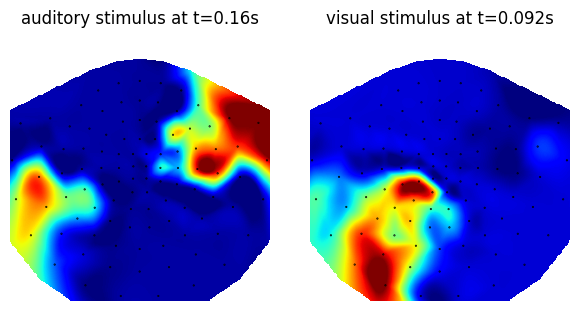
fig, axes = plt.subplots(figsize=(6, 3), nrows=1, ncols=2, layout="constrained")
plt.title("PCA of Gradcam mask")

for i, label in enumerate(dataset.target_labels):
    grayscale_cam = all_cams[i].mean(axis=0)
    grayscale_cam = (grayscale_cam - grayscale_cam.min()) / (grayscale_cam.max() - grayscale_cam.min())
    best_timing = grayscale_cam.max(axis=0).argmax()

    pca = PCA(10)
    # pca.fit(cams.mean(axis=0).T)
    pca.fit(all_cams[i][:,:,best_timing])
    component = pca.components_[0]
    component = (component - component.min()) / (component.max() - component.min())

    axes[i].set_title(f"{label} stimulus at t={(best_timing - 75)/sfreq}s")
    im, _ = plot_topomap(
        component,
        info,
        axes=axes[i],
        res=300,
        show=False,
        outlines=None,
        contours=0,
        cmap='viridis'
    )

out_path = os.path.join(fig_path, f"GradCAM_mask_PCA.png")
# plt.tight_layout()
plt.savefig(out_path, dpi=300)
plt.show()
[11]:
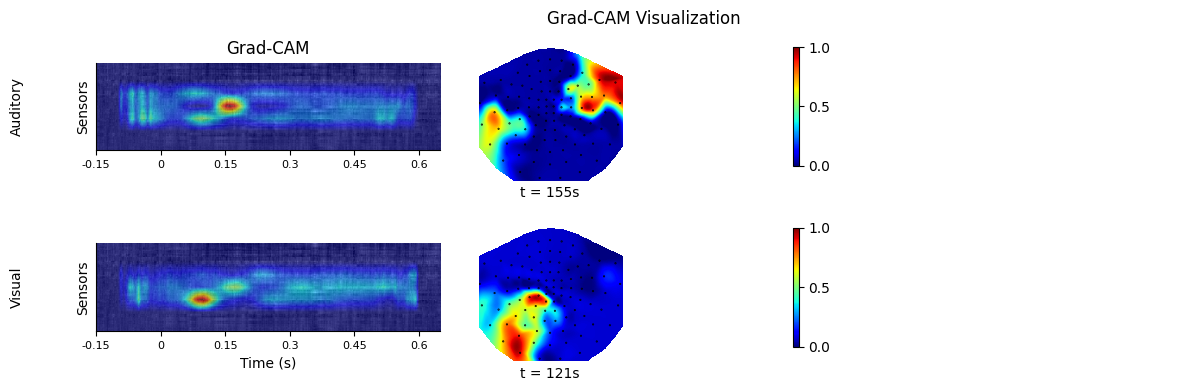
from matplotlib.gridspec import GridSpecimport matplotlib.pyplot as pltimport copyfrom mne.viz import plot_topomapfrom matplotlib.cm import ScalarMappablefrom matplotlib.colors import Normalizeoutlines = Nonetitle = "Grad-CAM Visualization"labels = ["Auditory", "Visual"]block_size = 5tick_ratio = 1000 / 500n_blocs = 1 # Only one "bloc" for Grad-CAMsn_lines = len(all_cams) # Number of lines for the pyplot figuren_cols = n_blocs * block_size + 1 # Number of columns for the pyplot figuregrid = GridSpec(n_lines, n_cols)fig = plt.figure(figsize=(n_cols * 2, n_lines * 2))plt.title(title)plt.axis("off")axes = []for i, (label, cams) in enumerate(zip(labels, all_cams)): grayscale_cam = all_cams[i].mean(axis=0) grayscale_cam = (grayscale_cam - grayscale_cam.min()) / (grayscale_cam.max() - grayscale_cam.min()) best_timing = grayscale_cam.max(axis=0).argmax() # PCA for topomap pca = PCA(10) pca.fit(all_cams[i][:, :, best_timing]) # Compute PCA on all cams at the best timing components = pca.components_ for j in range(0, n_blocs * block_size, block_size): idx = j // block_size length = grayscale_cam.shape[1] grads = grayscale_cam[:, :length] # No padding for Grad-CAMs axes.append(fig.add_subplot(grid[i, j : j + 2])) img = np.moveaxis(np.array(input_tensor[0]), 0, 2) img = np.array([img[:, :, 0]] * 3) img = np.moveaxis(img, 0, 2) plt.imshow(img, # interpolation=None, aspect=1, ) im = plt.imshow(grayscale_cam, cmap='viridis', alpha=0.6, aspect=1) # Overlay heatmap axes[-1].spines["top"].set_visible(False) axes[-1].spines["right"].set_visible(False) axes[-1].yaxis.tick_right() x_ticks = [0, int(length / 2), length] plt.xticks([0, 75, 150, 225, 300, 375], fontsize=8) axes[-1].set_xticklabels([-0.15, 0, 0.15, 0.3, 0.45, 0.6]) axes[-1].set_yticks([]) if j == 0: axes[-1].text(-100, 50, label, ha="left", va="center", rotation="vertical") # axes[-1].text(-100, 50, label, ha="left", va="center") if idx == n_blocs - 1: axes[-1].yaxis.set_label_position("left") if i == 0: plt.title("Grad-CAM") if i == 1: plt.xlabel("Time (s)") if idx == 0: axes[-1].set_ylabel("Sensors") # Add Topomaps # for comp in range(3): for comp in range(1): axes.append(fig.add_subplot(grid[i, j + 2 + comp])) topo_data = (components[comp] - components[comp].min()) / (components[comp].max() - components[comp].min()) # Normalize im_topo, _ = plot_topomap( topo_data, info, axes=axes[-1], res=300, show=False, contours=0, cmap='viridis', outlines=None, vlim = (-0.005, 1.1) ) var = 100*pca.explained_variance_ratio_[comp] print(f"explained variance of first component for label {label}: {var:.2f}%") # axes[-1].set_xlabel(f"t = {best_timing}s; var = {var:.2f}%") axes[-1].set_xlabel(f"t = {best_timing}s") if idx == n_blocs - 1: axes.append(fig.add_subplot(grid[i, n_blocs * 3 + comp ])) # Fix the alpha issue using ScalarMappable for the colorbar norm = Normalize(vmin=0, vmax=1) # Use the same vmin and vmax as the image sm = ScalarMappable(cmap='viridis', norm=norm) # Create a ScalarMappable for the colorbar sm.set_array([]) # Required to create a colorbar from ScalarMappable fig.colorbar( sm, ax=axes[-1], # Attach to the correct axis location="right", ticks=(0, 0.5, 1), # Use appropriate ticks shrink=0.8, # Adjust size as needed ) axes[-1].axis("off")out_path = "all_gradcams_visualization.png"plt.tight_layout()plt.savefig(os.path.join(fig_path, out_path), dpi=300)
explained variance of first component for label Auditory: 55.57%
explained variance of first component for label Visual: 71.85%